

OLIVE TREE AFFIRMATIONS
Ten Biblical Foundations for Christians and Churches Honoring the Jewish People
The Olive Tree Affirmations are ten biblical commitments that help Christians and churches honor the Jewish people and build healthier Jewish–Christian relationships.
Preface
One challenge has remained constant: Even those who opposed hostility toward Jews and Judaism have often lacked the theological grammar to explain why such attitudes contradict the gospel of Christ. The Olive Tree Affirmations help supply that language. They offer Christians a way to speak biblically and faithfully about God’s enduring covenant with the Jewish people and to reject the distortions that have justified prejudice in Christ’s name.
Across the Christian world, many sense the moment has arrived for leaders and communities to walk a healthier path—one that honors God’s irrevocable promises to Israel, renounces replacement theology, and nurtures relationships with humility, clarity, and respect.
This work is an act of renewal as much as it is repentance. When Christians honor the Jewish people and the Jewish roots of their own story, the church does not lose itself; it finds itself. Returning to the biblical story through its original Jewish soil strengthens Christian faith, deepens Christian hope, and expands Christian love. Paul’s image in Romans 11:17 reminds us that Gentile believers share in Israel’s nourishing root not as replacements, but as companions grafted into the same living tree.
These affirmations are a posture to embody in our teaching, relationships, and life together. They offer a way of communicating that builds trust rather than suspicion, promotes healing rather than harm, and cultivates blessing rather than rivalry. They echo Paul’s conviction that God’s promises to Israel are irrevocable, and they call Christians into a renewed way of seeing and speaking.
These affirmations matter regardless of whether Christians live near Jewish communities. They shape how we think and pray, how we preach and teach, and how we imagine God’s faithfulness and our own. They invite us to become better stewards of the story we have received—a story rooted in the faithfulness of the God of Israel.
The Olive Tree Affirmations give Christians a language for expressing what many already feel: a conviction to challenge anti-Semitism, resist replacement theology, and rebuild the relationship with their ancient spiritual siblings, the Jewish people.
Many Christians throughout the centuries have wrestled with how to speak and relate to the Jewish people. At times, this search has opened doors to humility, learning, and friendship. Yet far too often, Christian interpretation has given rise to distortion, to erasure, and, at its worst, to wounds that echo across generations.
In our time, many Christians have begun turning toward healing.
They are recovering readings of Scripture that make space for friendship rather than fear, and they are discovering anew that the New Testament can foster, rather than sever, a life-giving bond with the Jewish people and Judaism. Some Christians describe this discovery as finding something they always sensed was missing. These are hopeful beginnings, but the work is not complete. And, in truth, we are not the first to walk this road.
Jewish–Christian relations have strengthened over the last century through landmark scholarly, ecclesial, and interreligious statements, such as Nostra Aetate. Yet despite this important progress, much of this work has not reached ordinary congregations, pastors, and lay believers. The Olive Tree Affirmations seek to stand on these shoulders and bring this essential work into the day-to-day life of regular people in pulpits and pews. These affirmations provide clear language for resisting anti-Semitism and explain why honoring the Jewish people belongs at the heart of Christian faithfulness.
10 Affirmations
These commitments move Christians beyond sentiment into practices that dismantle inherited anti-Jewish assumptions and repair Jewish–Christian trust.
A full version of the Affirmations, with explanatory paragraphs for each affirmation, can be downloaded below.
1) We affirm that God’s covenant with the Jewish people is enduring, unbreakable, and must remain visible in Christian teaching.
2) We affirm that Christian faith was never designed to exist apart from a positive and respectful relationship with the Jewish people.
3) We affirm that Judaism was not a problem Jesus came to solve.
4) We affirm that using the New Testament to justify anti-Semitism or anti-Judaism is contrary to the gospel.
5) We affirm that authentic learning requires engaging with Jewish voices, Jewish texts, and Jewish lived experience.
6) We affirm that friendship with the Jewish people and support of Israel must not be driven by the hidden aim of converting Jewish people.
7) We affirm that God’s covenant with the Jewish people and the redemption Christians find in Christ are not in competition; God is faithful to both.
9) We affirm that Christian use of Scripture must be aware of its impact on living Jewish communities today.
8) We affirm the Jewish people’s covenantal bond to the land of Israel.
10) We affirm that genuine relationship honors real differences without framing them as deficiencies.
Order Affirmation Cards

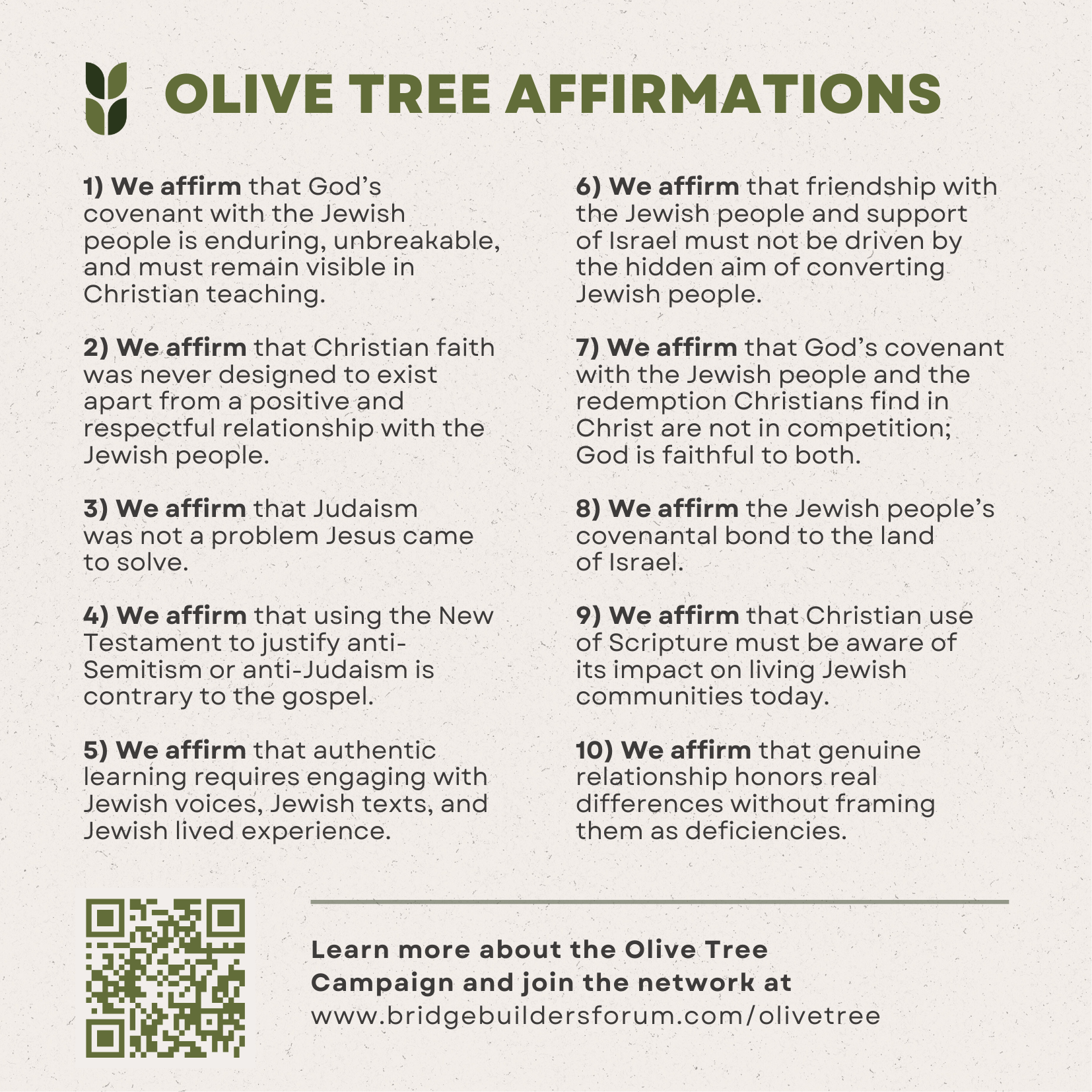
When you give $55 or more, we’ll send you 50 Olive Tree Campaign cards to help you share this message. Or, become a Bridge Builder (monthly, recurring donor of $25 or more) and we will send you one set of 50 of these cards for free. If you are already a Bridge Builder, please email us at info@bridgebuildersforum.com, and we will be happy to arrange a set to be sent to you. Please contact us at info@bridgebuildersforum.com if you would like more than 50 cards.
Putting The Affirmations Into Practice
Read Jewish scholars, follow Jewish teachers, and learn from Jewish sources rather than relying solely on Christian summaries.
Actively seek Jewish voices.
1
Reach out to Jewish neighbors, colleagues, rabbis, and communities for the sake of genuine relationship, not agenda.
2
Build real friendship.
Practice precise language when teaching Scripture.
3
Avoid sweeping generalizations such as “the Jews rejected Jesus.”
Evaluate Christian curricula for anti-Judaism.
4
Review doctrinal statements, sermons, and studies, and remove supersessionist or erasing language.
Honor the beauty of Jewish tradition in its own context through Torah-informed learning and study.
Respect and learn from Jewish tradition.
5
Pray for the peace and flourishing of the Jewish people.
6
Pray with humility and trust in the God who is faithful to Israel.
Support Israel in ways that affirm Jewish dignity.
7
Engage in ways that arise from love and covenantal respect rather than eschatological agendas.
Build community in Jewish spaces.
8
Attend synagogue services, lectures, museums, and be present in other Jewish contexts.
Be sensitive to language that perpetuates anti-Jewish stereotypes.
9
Avoid using terms like “Pharisees” as insults or equating Jewish practice with hypocrisy.
Teach openly that Christian tradition has too often fueled antisemitism. Naming the harm is the beginning of repair.